Commercial Concrete Polishing in Tampa for High-Traffic Areas
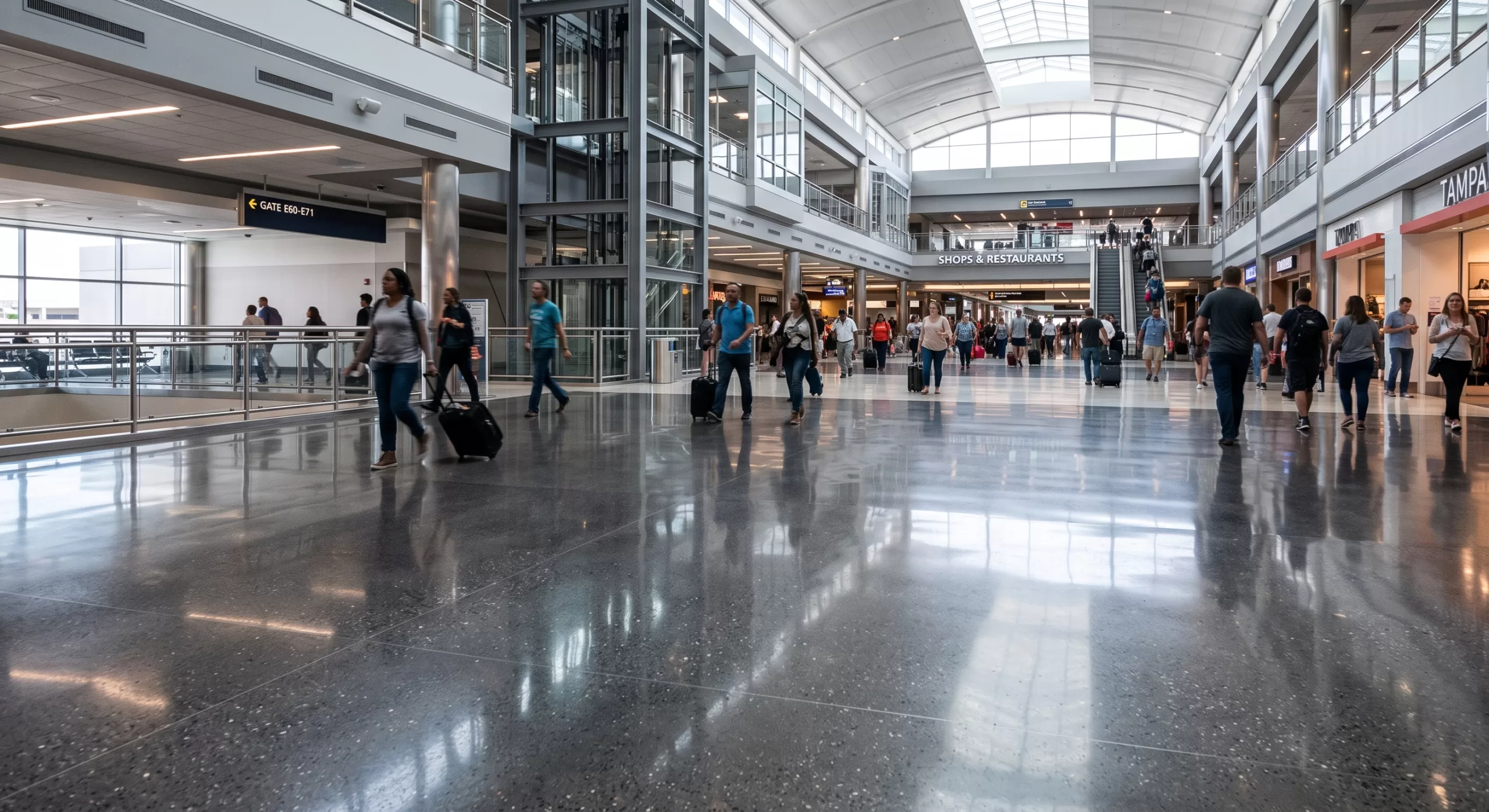
Commercial floors take a beating. With foot traffic, carts, forklifts, deliveries, dirt and spills, as well as routine cleaning, enough to wear down a surface. Polishing allows businesses in Tampa that already have a concrete slab to go ahead and use the slab as their finished floor (rather than cover it with some other flooring material). Concrete Polishing & Epoxy Florida – The Best Commercial Concrete Polishing in Tampa Area. Polished concrete is ideal for locations that need to withstand wear-and-tear associated with ongoing use and maintenance, such as warehouses, distribution centers, retail spaces, showrooms, restaurants, and other commercial settings.
Yet even a high-traffic need does not automatically conclude that polished concrete is the appropriate selection. The condition of the existing slab, the type of traffic, exposure to chemicals or spills, and desired look and maintenance plan all come into play with floor performance.
Key Takeaways
- With commercial concrete polishing, you are taking the existing concrete slab and making it the finished floor; there is no other covering that has to deal with daily traffic.
- Polished concrete is suitable for warehouses, shops, offices, showrooms and similar high-traffic / hard-wearing indoor areas – provided that the slab has been properly prepared for polishing.
- While a concrete densifier can help with surface hardness, it is not to be confused with a structural repair of a weak or deteriorating slab.
- Getting the right sheen is not always getting the shiniest top coat. The finish level should be driven by traffic, lighting, cleaning practices, and aesthetic goals.
- Even a resilient polished floor needs a sensible cleansing program, as dirt and grit can act like abrasives underneath heavy foot traffic.
- Commercial polishing projects should review for items such as cracks, existing coatings, surface damage, oil contamination, or weak concrete.
Why Does Polished Concrete Work Well in High-Traffic Commercial Areas?
Polished concrete works well in many high-traffic commercial areas because the concrete slab itself becomes the finished walking or working surface. Mechanical grinding, honing, polishing, and densification refine the surface rather than hiding it beneath carpet, tile, or a conventional floor covering.
The Concrete Polishing Council describes polished concrete as a surface processed through grinding, honing, and polishing to reach a specified finish and gloss. ACI/ASCC also publishes a dedicated specification, ACI 310.1-20, covering polished concrete slab finishes, including construction, testing, evaluation, and acceptance requirements.
For a busy facility, that matters for several reasons.
There Is No Traditional Floor Covering to Wear Through
A mechanically polished floor does not depend on tile, carpet, or another covering installed over the slab. The concrete itself is refined into the finished surface.
That can remove some common flooring concerns such as loose flooring materials, worn carpet paths, or peeling conventional floor paint.
A polished floor may still receive a stain-protection treatment or guard depending on the project. Those products can require maintenance over time, so it is more accurate to say the polished concrete itself is not a topical coating rather than saying nothing on the floor will ever need reapplication.
The Surface Can Be Hardened During the Polishing Process
Concrete polishing commonly includes a densifier. These silicate-based products react within the concrete surface and are used as surface hardeners or densifiers. They can help produce a harder, more polishable wear surface.
One distinction is important: a densifier improves the concrete surface. It does not turn structurally deficient concrete into a sound slab.
The American Concrete Institute notes that weak concrete surfaces can experience lower gloss, aggregate loss, and reduced service life even when a densifier is used as part of remediation. That is why slab evaluation matters before we start grinding.
Routine Maintenance Is Relatively Straightforward
For many commercial properties, polished concrete is attractive because routine care does not require waxing in the same way some traditional floor finishes do.
Regular dust removal is still important. Sand, grit, and debris brought through entrances can become abrasive under thousands of footsteps or repeated cart traffic. Spills should also be cleaned rather than left on the floor, particularly in food service, automotive, warehouse, and similar environments.
A floor that is durable is not a floor that can be ignored.
Which Tampa Commercial Properties Are Good Candidates for Polished Concrete?
While polished concrete can work in many commercial and industrial interiors, the floor goes through unique stresses based on the type of goods being stored or manufactured in a building.
Our commercial Tampa concrete flooring services cover warehouses and distribution facilities, automotive centers and dealerships, restaurants and breweries, retail stores and showrooms as well as offices and lobbies.
Warehouses and Distribution Facilities
Warehouses want more than a floor that it looks clean.
The areas with the most wear can be specific routes for forklifts, movement of pallets or loaded carts, storage activities, and a lot of traffic. Polished concrete can perhaps be more viable since it essentially employs the structural floor slab as its working surface, thus avoiding an additional flooring layer on top.
Now, before polishing a warehouse, you need to take into account pre-existing joints, fractures, repairs, surface flatness, contaminants, and heavy traffic aisleway conditions.
Retail Stores and Showrooms
Retail floors need to handle traffic while still contributing to the appearance of the space.
Polishing can expose anything from very little aggregate to more visible stone depending on the existing slab and how deeply it is ground. The floor can also be refined to different sheen levels.
That makes polished concrete flexible, but the final appearance is influenced by the concrete already in the building. Existing patches, cracks, discoloration, and variations in aggregate do not necessarily disappear when the floor is polished.
For some businesses, that natural variation is part of the appeal. Others may want a more uniform finish and should discuss those expectations before work begins.
Offices and Lobbies
An office or lobby normally experiences different traffic than a warehouse. Here, appearance, acoustics, cleaning, glare, and visitor traffic may matter more than forklift abrasion.
A high-gloss floor can create a bright, refined look, but maximum gloss is not automatically the best specification for every office. A lower or medium sheen may provide the appearance the business wants with less emphasis on reflections, dust, or minor marks.
Restaurants, Breweries, and Food-Service Areas
Polished concrete can work in some restaurant and hospitality environments, but spill exposure deserves additional attention.
Water, oils, acidic liquids, food spills, grease, and cleaning chemicals can create different challenges than ordinary foot traffic. The floor’s stain-protection system and maintenance procedures therefore matter just as much as its shine.
Businesses should also evaluate whether polished concrete or a purpose-built coating system better matches the specific environment.

Commercial Concrete Polishing in Tampa
Get a Free Epoxy Flooring Estimate
Speak with Our Team! Call Now!
What Happens During Commercial Concrete Polishing?
Commercial concrete polishing is a multi-stage mechanical process. The exact sequence depends on the slab and the specified finish, but the work generally progresses from initial surface preparation to finer honing and polishing.
1. Evaluate and Prepare the Existing Concrete
Before choosing abrasives or a gloss level, we need to understand what is already on the floor.
The slab may have old coatings, adhesive, paint, repairs, cracks, stains, curing compounds, or damage from years of use. Some surfaces need considerably more preparation than clean, newly placed concrete.
Surface repairs can also affect project cost and appearance. ACI notes that many floors require repair before polishing because of placement conditions, finishing, or damage sustained during use or construction.
This is one reason two commercial buildings with the same square footage may require very different amounts of work.
2. Grind and Hone the Surface
Industrial diamond tooling is used to mechanically refine the concrete.
Coarser tooling may be needed for substantial surface correction, coating removal, or aggregate exposure. Progressively finer abrasives then hone the surface toward the specified finish.
The depth of grinding matters. A light polish may preserve more of the original surface appearance, while deeper grinding can expose more sand or coarse aggregate.
3. Apply a Concrete Densifier
A densifier is typically introduced during the polishing process to harden and tighten the concrete surface.
Its performance depends partly on the concrete itself. Porosity, hardness, curing history, and other slab characteristics can influence how the material reacts.
For a commercial owner, the practical point is simple: polishing is not one identical recipe applied to every slab.
4. Continue Polishing to the Selected Sheen
Finer tooling refines the floor until it reaches the specified level of gloss and clarity.
Commercial floors do not have to be mirror-like. Depending on the space, a satin or medium-gloss finish may be more appropriate than a highly reflective finish.
5. Apply Stain Protection When Specified
A penetrating stain protector or compatible guard may be used to help protect the finished concrete from spills and staining.
The Concrete Polishing Council distinguishes between penetrating stain protection and very thin film-forming stain-protection products. That distinction matters because protection systems have different maintenance requirements.
Is Highly Polished Concrete Slippery?
A polished appearance does not automatically mean a floor is dangerously slippery.
Testing referenced by the Concrete Polishing Council found that polished concrete test sections exceeded the DCOF value used in that testing program, including high-gloss surfaces. The council also notes that slip performance can vary with gloss level.
Real buildings add another variable: contamination.
Rainwater tracked through an entrance, grease near food preparation areas, automotive fluids, dust, or cleaning residue can change traction on almost any hard flooring surface. For a Tampa commercial property, entrance matting, prompt spill cleanup, correct cleaning products, and a maintenance plan are therefore important parts of floor safety.
If slip resistance is a critical requirement for the project, it should be specified and evaluated rather than assumed from appearance alone.
What Can Shorten the Life of a Polished Commercial Floor?
Heavy traffic is only one source of wear. A polished floor can lose appearance or performance faster when the surface starts with weak concrete or the maintenance program allows abrasive debris to remain on the floor.
Pay particular attention to:
- weak or deteriorating surface concrete;
- unresolved cracks and damaged joints;
- oils or other contamination in an older slab;
- repeated exposure to chemicals the protection system was not designed to handle;
- abrasive dirt and grit left in high-traffic lanes;
- inappropriate cleaning chemicals;
- neglected entrance areas where water and debris are routinely tracked indoors;
- unrealistic expectations about stains, patches, cracks, or aggregate exposure in an existing slab.
For an older commercial property, these conditions should be evaluated before the business chooses a finish based mainly on photographs or gloss level.
Polished Concrete vs. Epoxy for High-Traffic Floors
Neither system is automatically better for every high-traffic commercial building.
Polished concrete is often a strong candidate when a business wants to use the existing slab as the finished surface, prefers the appearance of natural concrete, and values straightforward routine maintenance.
Epoxy or another resinous coating system may make more sense when the project calls for a specific coating build, color system, decorative flake, or other surface characteristics that polished concrete alone does not provide.
At Concrete Polishing & Epoxy Florida, we install both polished concrete and epoxy flooring in Tampa. That allows us to look at the actual demands of the space instead of treating one flooring system as the answer to every project.
For example, a dry retail showroom and a service area exposed to frequent automotive fluids may have very different flooring priorities even if both experience heavy traffic.
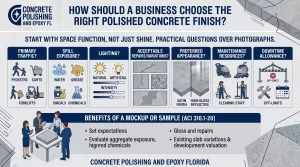
How Should a Business Choose the Right Polished Concrete Finish?
Start with how the space will be used, not simply how shiny you want it to look.
For a commercial project, we recommend considering several practical questions before settling on the final specification:
- Will the primary traffic come from pedestrians, carts, forklifts, or a combination?
- Does the facility routinely deal with water, grease, chemicals, or food spills?
- How much natural and artificial light reaches the floor?
- Will repairs, cracks, or aggregate variations be acceptable as part of the finished appearance?
- Does the business prefer a satin appearance or a strongly reflective floor?
- What cleaning equipment and maintenance staff are available?
- Can the area be taken out of service long enough for preparation and polishing?
These factors often matter more than selecting a finish from a photograph.
A sample or mockup can also help establish expectations on larger projects, particularly when aggregate exposure, gloss, repairs, or existing slab variation will strongly influence the finished look. ACI 310.1-20 specifically addresses mockups and evaluation criteria as part of polished concrete project specifications.
Get a Free Epoxy Flooring Estimate
Speak with Our Team! Call Now!
Why Slab Condition Matters Before We Polish
The best polishing system cannot erase every problem in an existing concrete slab.
Before a commercial project begins, we look at the condition of the concrete because cracks, spalling, old repairs, coatings, adhesive residue, stains, weak surface material, and previous floor treatments can change both the process and the finished appearance.
Existing slabs also have history. A former warehouse, retail store, restaurant, or industrial space may reveal patched areas or color differences once old flooring is removed.
That does not automatically rule out polishing. It does mean those conditions should be identified early so the business knows what can realistically be improved and what will remain visible.
Commercial Concrete Polishing in Tampa Bay
Concrete Polishing & Epoxy Florida provides polished concrete and other concrete flooring services from our Tampa location at 6102 E Adamo Drive. Our service area includes Tampa and surrounding communities such as St. Petersburg, Clearwater, Brandon, Riverview, Palm Harbor, Plant City, Wesley Chapel, and other parts of the Tampa Bay area.
For commercial projects, we work with the existing floor conditions and the performance demands of the space to determine whether polishing is appropriate and what preparation the slab may need.
That evaluation is especially important in high-traffic buildings. The best floor is not simply the one with the highest gloss. It is the one that fits the traffic, cleaning routine, slab condition, appearance expectations, and day-to-day operation of the facility.
Get a Commercial Concrete Polishing Estimate in Tampa
A high-traffic floor needs more than a good-looking finish. The slab has to be suitable for the process, the finish should fit the way the building operates, and the maintenance plan needs to match the traffic the floor receives.
At Concrete Polishing & Epoxy Florida, we provide commercial concrete polishing in Tampa and throughout the surrounding Tampa Bay area. We can evaluate your existing concrete, discuss how the space is used, and explain whether polished concrete or another flooring system better fits the project.
Request a free estimate to discuss your commercial concrete flooring project with our Tampa team.
Frequently Asked Questions
Q: How long does commercial polished concrete last?
A: Polished concrete can provide a long service life when the concrete is sound, and the floor is maintained correctly. Actual longevity depends on slab quality, traffic, contaminants, maintenance practices, and the level of wear the facility creates. Weak surface concrete can reduce the service life of a polished finish.
Q: Can an old commercial concrete floor be polished?
A: Many existing commercial slabs can be polished, but they should be evaluated first. Old coatings, adhesive, cracks, patches, contamination, surface damage, and weak concrete can require additional preparation or affect the final appearance.
Q: Does polished concrete need to be resealed?
A: The polished concrete itself is created mechanically rather than applied as a conventional coating. However, a project may use penetrating stain protection or a thin protective guard, and those products can have their own maintenance or reapplication requirements.
Q: Is polished concrete good for forklift traffic?
A: Polished concrete is commonly used in warehouse and industrial environments that experience equipment traffic. The slab condition, joints, wheel type, loading, maintenance practices, and operating environment still need to be considered for an individual facility.
Q: Can polished concrete be repaired if the floor already has cracks?
A: Cracks and surface defects can often be repaired before or during the polishing process, but repairs may remain visible. The appropriate repair method depends on the defect and the condition of the surrounding concrete. Repair expectations should be discussed before polishing begins.
Q: Should I choose polished concrete or epoxy for my Tampa business?
A: Choose based on how the floor will be used. Polished concrete is often well suited to businesses that want to use the existing slab as the finished surface, while an epoxy system may be preferable when a specific coating system, decorative finish, or different surface performance is required. We offer both systems, so the decision can be based on the space rather than forcing one material into every application.
Recent Posts