Epoxy Flooring Specialist for Tampa Commercial Spaces
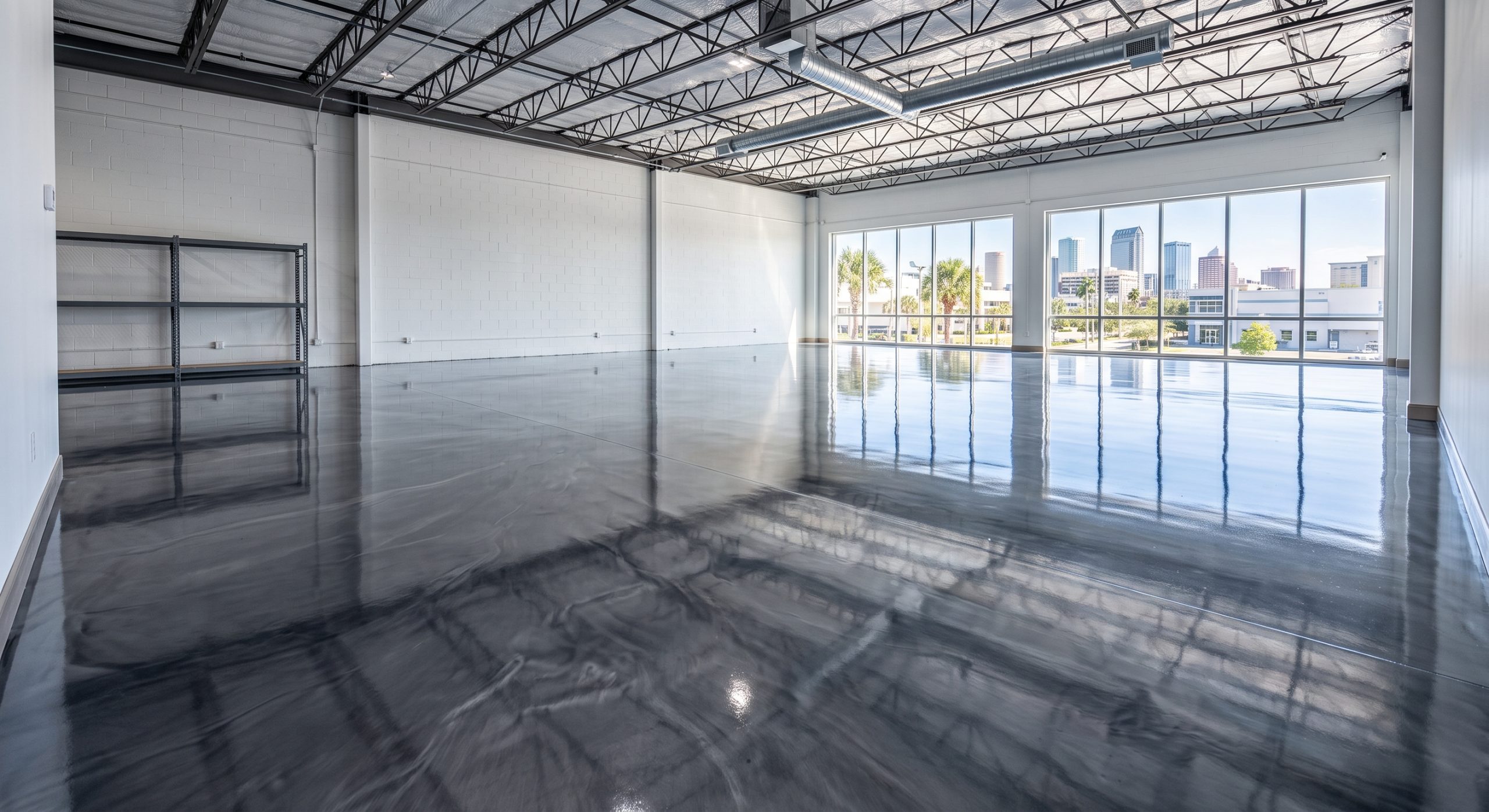
Commercial floors have to do more than look clean. They may need to handle steady foot traffic, carts, equipment, spills, vehicle traffic, frequent cleaning, and the day-to-day wear that comes with running a business. That is why choosing an epoxy flooring specialist involves more than picking a color or finish.
At Concrete Polishing & Epoxy Florida, we provide epoxy flooring and concrete flooring solutions for commercial properties throughout Tampa and the surrounding area. The right system starts with understanding how the space is used, what condition the concrete is in, and what the floor will be expected to handle once the business is back in operation.
Key Takeaways
- A commercial epoxy floor is only as reliable as the preparation done of the substrate underneath it.
- That can change which flooring system makes sense, since traffic, chemicals, moisture, cleaning requirements and downtime all come into play.
- Before installing a coating, the surface needs to be inspected for cracks, pits, uneven areas and any other concrete issues.
- Epoxy is an option for most commercial settings, but polished concrete or another type of coating system might be best in some spaces.
- Tampa is hot and humid; therefore, slab condition and moisture are particularly crucial factors prior to coating concrete.
- An epoxy flooring expert doesn’t base their recommendation on selling the same coating for every floor; instead, they recommend a system based on how the facility runs.
What Does an Epoxy Flooring Specialist Do?
Epoxy flooring professionals assess and prepare the concrete, then lay a resin-based floor system design for that space’s environment.
Coating is only one part of the deal.
Surface preparation, concrete repairs, base coats and protective topcoats are all done commercially as well as decorative or functional broadcast materials. How exactly depends on the current slab and how we need the finished floor to be able to withstand.
Proper preparation is especially important. No matter how good a coating material one uses, if placed over contaminated, soft, damaged or inadequately prepared concrete, it may not stick at all.
Most floors will require mechanical preparation of the concrete to ensure the coating can achieve proper bonding. Other factors that can cause issues before the system is installed include the presence of cracks, spalled areas, pits, and joints in the surface layer as well as existing coatings or moisture.
Why Surface Preparation Matters More Than Most Businesses Realize
Surface preparation is one of the greatest influences in determining how a commercial epoxy floor performs.
Even concrete that appears somewhat clean can contain oils, sealers, contaminants, old coatings, and other products that inhibit adhesion. Washing the floor does not create a surface profile like mechanical preparation.
Depending on the slab, professional preparation can include diamond grinding or other mechanical methods that strip away weak surface material and expose sound concrete.
Adequate preparation provides a better chance of spotting potential problems that may remain concealed under the final coat.
Cracks and Damaged Concrete Need Attention First
Epoxy does not make structural or surface problems vanish.
Before the coating system is applied, cracks, pitting, spalling of uneven areas and damaged joints must be assessed. Certain defects owners can restore through floor preparation, while others might reveal a more serious concrete problem that requires an alternate solution.
The bottom line is simple: the slab that exists determines what can be placed over it reasonably.
Moisture Can Affect Coating Performance
Moisture deserves special attention with concrete flooring in Florida.
Concrete is porous, and moisture vapor can move through a slab from below. If that moisture becomes trapped beneath a coating system, it can contribute to problems such as blistering or loss of adhesion.
That does not mean every Tampa commercial floor has a moisture problem. It means moisture conditions should not be ignored when there are signs of vapor transmission, a history of coating failure, or other reasons to question the condition of the slab.
Depending on what an evaluation finds, additional moisture testing or mitigation may be appropriate before the final flooring system is selected.
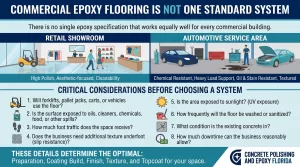
Commercial Epoxy Flooring Is Not One Standard System
There is no single epoxy specification that works equally well for every commercial building.
A retail showroom and an automotive service area may both use epoxy, but the demands placed on those floors are very different.
Before choosing a system, we consider questions such as:
- Will forklifts, pallet jacks, carts, or vehicles use the floor?
- Is the surface exposed to oils, cleaners, chemicals, food, or other spills?
- How much foot traffic does the space receive?
- Does the business need additional texture underfoot?
- Is the area exposed to sunlight?
- How frequently will the floor be washed or sanitized?
- What condition is the existing concrete in?
- How much downtime can the business reasonably allow?
Those details help determine the preparation, coating build, finish, texture, and topcoat that make sense for the space.
Get a Free Epoxy Flooring Estimate
Speak with Our Team! Call Now!
Where Does Commercial Epoxy Flooring Work Well?
Epoxy flooring can be a practical choice for many commercial and light-industrial concrete floors where businesses need a seamless, durable, and easy-to-maintain surface.
At Concrete Polishing & Epoxy Florida, we work with commercial environments that include automotive centers and dealerships, warehouses and distribution facilities, restaurants and breweries, retail shops and showrooms, corporate offices, and lobbies.
The flooring requirements still vary considerably within those categories.
Warehouses and Distribution Facilities
Warehouse floors may deal with rolling loads, pallets, carts, equipment, and constant movement.
For these spaces, appearance matters less than choosing a system capable of handling the actual traffic pattern. Loading areas or equipment paths may experience much more abrasion than lightly used portions of the same facility.
The condition of the slab also matters. A warehouse with older concrete, previous repairs, or worn traffic lanes needs to be evaluated differently from a newer, relatively uniform slab.
Automotive Centers and Dealerships
Automotive floors can be exposed to tire traffic, oils, fluids, tools, cleaning products, and abrasion.
Service areas may need a different texture and coating build than customer-facing showroom floors. A glossy decorative finish may work well in one section while a more functional surface is appropriate in another.
This is a good example of why commercial flooring should be specified according to the area rather than treating the entire building as one identical application.
Restaurants and Breweries
Food and beverage environments place their own demands on a floor.
Frequent cleaning, spills, moisture, foot traffic, and operational requirements can influence the flooring decision. Surface texture deserves particular attention because a smoother finish and a more aggressive texture behave differently when the floor is wet and when employees need to clean it.
The existing floor layout, drains, transitions, and concrete condition should also be considered before work begins.
Retail Stores and Showrooms
Retail and showroom floors have to balance appearance with everyday wear.
Epoxy systems can create a clean, finished surface and allow for different colors and decorative effects. The right finish depends on the atmosphere of the space as well as the amount and type of traffic it receives.
For areas with substantial natural light or UV exposure, the complete coating system and topcoat selection also deserve consideration rather than choosing epoxy based on appearance alone.
Offices and Commercial Lobbies
Some offices, reception areas, and lobbies use coated concrete because they want a seamless surface with a more finished appearance.
These spaces typically face different stresses than warehouses or automotive areas, so an extremely heavy-duty system is not automatically necessary.
Matching the floor to its actual use can avoid paying for features the property does not need while still producing a durable finish.
Epoxy, Flake, or Another Finish: Which Makes Sense?
The best commercial concrete floor is not automatically epoxy.
At Concrete Polishing & Epoxy Florida, our services also include epoxy flake flooring, concrete polishing, concrete sealing, and concrete resurfacing. That gives us several ways to approach a commercial concrete floor depending on its condition and the client’s goals.
Traditional Epoxy Coatings
Epoxy can provide a seamless, high-build surface with a wide range of colors and finish options.
It is commonly considered where businesses want durability, stain resistance, easier maintenance, and a more finished appearance over existing concrete.
The actual performance depends on the system selected, surface preparation, installation conditions, and how the facility uses the floor.
Epoxy Flake Flooring
A flake system adds decorative chips to the coating rather than leaving a plain solid-color surface.
Besides changing the appearance, flake can help create visual texture and hide minor dirt or wear better than some highly uniform finishes.
The amount of texture and topcoat still needs to match the intended use of the space.
Polished Concrete
Polished concrete is worth considering when a business wants to use the concrete itself as the finished surface rather than covering it with a resinous coating.
The concrete is mechanically ground and polished to create a smooth, refined surface.
For some retail, office, showroom, warehouse, and similar commercial interiors, polished concrete can offer an attractive alternative to a coating system. Existing slab condition, desired appearance, exposure, and maintenance expectations all influence whether polishing or epoxy makes more sense.
How Do You Choose the Right Commercial Epoxy System?
Start with the demands of the facility rather than the appearance of a sample board.
A floor that performs well in a lightly used retail space might not be appropriate for a service bay or distribution facility.
1. Identify the Main Type of Traffic
Determine whether the floor will primarily handle people, carts, rolling equipment, vehicles, or a mixture of these.
Pay attention to concentrated traffic as well. A narrow forklift route can experience more wear than the rest of a large warehouse.
2. Identify Chemical and Spill Exposure
Think about what actually reaches the floor during a normal workweek.
Oil, grease, food products, cleaning agents, automotive fluids, and other chemicals can influence system selection.
3. Consider Slip Resistance and Cleaning
More texture can provide additional grip, but it can also change how the floor feels and how easily it is cleaned.
That trade-off should be considered before the floor is installed, particularly in areas where water, food, oils, or other liquids may regularly reach the surface.
4. Evaluate the Existing Concrete
A new coating cannot compensate for every substrate problem.
The concrete should be checked for cracks, damage, existing coatings, contamination, surface weakness, uneven areas, and potential moisture concerns. The findings may change the preparation requirements or even the type of flooring recommended.
5. Plan Around Business Downtime
Commercial flooring work affects operations.
Furniture, inventory, equipment, vehicles, or production areas may need to be moved. The floor needs time for preparation, installation, and curing before normal use resumes.
Planning the sequence ahead of time can be just as important as choosing the coating itself.
How Long Does Commercial Epoxy Flooring Installation Take?
The installation schedule depends on the size and condition of the floor, preparation requirements, repairs, coating system, number of layers, cure times, and site access.
A straightforward open floor in good condition may move faster than an older commercial slab that needs extensive grinding and repairs.
For an operating business, return-to-service requirements should be discussed before the project begins. A fast installation has little value if the coating is placed over concrete that needed more preparation.
The goal should be an efficient schedule without compromising the work underneath the finished floor.
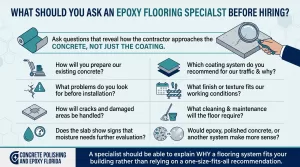
What Should You Ask an Epoxy Flooring Specialist Before Hiring?
Ask questions that reveal how the contractor approaches the concrete, not just the coating.
Useful questions include:
- How will you prepare our existing concrete?
- What problems do you look for before installation?
- How will cracks and damaged areas be handled?
- Does the slab show any signs that moisture needs further evaluation?
- Which coating system do you recommend for our traffic and why?
- What finish or texture fits our working conditions?
- How long will the area need to remain out of service?
- What cleaning and maintenance will the floor require?
- Would epoxy, polished concrete, or another system make more sense for this particular space?
A specialist should be able to explain why a flooring system fits the building rather than relying on a one-size-fits-all recommendation.
Get a Free Epoxy Flooring Estimate
Speak with Our Team! Call Now!
Why Local Conditions Matter for Tampa Commercial Floors
Tampa businesses operate in a warm, humid climate, which can influence concrete and flooring decisions.
Ground-level slabs can face moisture concerns. Areas close to open doors or exterior spaces may also experience more heat, humidity, tracked-in water, and sunlight than fully conditioned interiors.
Those conditions do not automatically dictate one flooring material. They are variables that should be considered alongside traffic, slab condition, chemical exposure, cleaning practices, and the way the property is used.
A floor that performs well starts with understanding the whole environment.
Work With an Epoxy Flooring Specialist in Tampa
Beneath the surface is where an effective commercial epoxy floor originates.
At Concrete Polishing & Epoxy Florida, we start with the concrete and the requirements of the space before figuring out which finish. For Tampa Bay area businesses, we offer epoxy flooring solutions including epoxy coating, epoxy flake flooring, concrete polishing and sealing, as well as resurfacing.
We specialize in commercial flooring such as warehouses, distribution centers, automotive facilities, restaurants, breweries, retail stores, showrooms, and offices and lobbies.
If you are laying out a new commercial floor or wondering how to manage worn concrete, we get the balance right by evaluating how your space is used and then discussing which flooring options best fit your use of the property.
Get a Free Estimate to Discuss Your Tampa Commercial Concrete Flooring Project
Frequently Asked Questions
Q: Is epoxy flooring good for commercial spaces?
A: Yes. Epoxy can be a practical flooring option for many commercial spaces because it creates a seamless surface that can withstand regular traffic and is easier to clean than untreated concrete. The appropriate system depends on traffic, chemical exposure, concrete condition, moisture, surface texture requirements, and other operating conditions.
Q: How should concrete be prepared before epoxy flooring?
A: Commercial concrete normally requires more than basic cleaning before epoxy is applied. Mechanical preparation, such as grinding, can remove weak surface material and create the profile needed for the coating to bond. Existing coatings, cracks, pits, contamination, and other defects should also be evaluated before installation.
Q: Can epoxy be installed over cracked concrete?
A: Some cracks and surface defects can be repaired before an epoxy system is installed, but coating over a crack does not eliminate the cause of the movement. The crack should first be evaluated so the appropriate repair method and flooring approach can be determined.
Q: Is moisture a problem for epoxy floors in Tampa?
A: It can be. Moisture vapor moving through concrete can interfere with some coating systems and may contribute to blistering or loss of adhesion. Not every slab requires mitigation, but floors with moisture concerns or previous coating failures may need further evaluation or testing before a new system is installed.
Q: Is epoxy better than polished concrete for commercial flooring?
A: Neither option is universally better. Epoxy creates a resinous coating over concrete and offers a broad range of colors, textures, and system builds. Polished concrete uses the slab itself as the finished surface. Traffic, slab condition, appearance, maintenance, exposure, and facility requirements determine which option makes more sense.
Q: How do I choose an epoxy flooring specialist in Tampa?
A: Look beyond color samples and price per square foot. Ask how the contractor prepares concrete, handles cracks and damaged areas, evaluates moisture concerns, selects systems for different traffic conditions, and plans around operational downtime. The recommendation should fit your facility instead of applying the same coating specification to every project.
Recent Posts