Professional Epoxy Garage Floor Coating for Tampa Garages
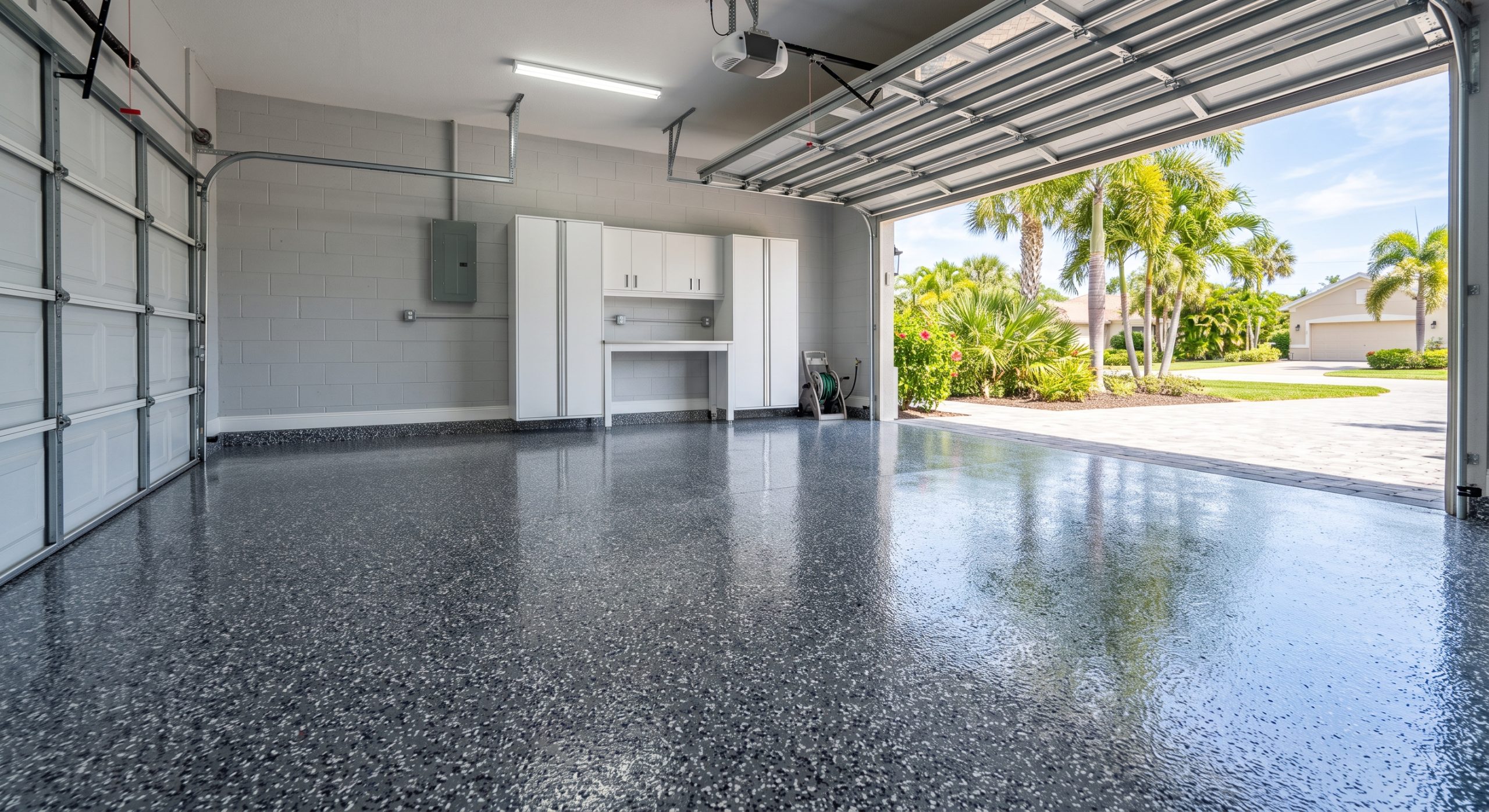
A garage floor in Tampa has to deal with more than parked cars. Heat, humidity, tracked-in rain, oil, chemicals, tire traffic, and moisture moving through concrete can all affect how a coating performs. That is why a professional epoxy garage floor coating is more than a decorative layer rolled over concrete. The condition of the slab, surface preparation, repairs, coating system, and final topcoat all affect whether the finished floor holds up or begins showing problems.
At Concrete Polishing & Epoxy Florida, we install epoxy flooring for Tampa homeowners who want a garage floor that is easier to maintain, more resistant to everyday wear, and finished to match the way they use the space. Our residential epoxy options include solid colors, decorative flakes, metallic finishes, concrete repair, crack filling, and surface preparation.
Key Takeaways
- Concrete preparation is heavily relied upon for a professional epoxy garage floor coating, since poor surface prep can eliminate adhesion when coating over poorly prepared concrete.
- With Tampa’s heat, humidity, and moisture from the slab, obtaining moisture conditions is a key component in creating a garage coating system.
- Given that any cracks, pits or areas of damage and existing coatings need to be repaired and removed, respectively, prior to the system being applied.
- Decorative flakes, solid colors and metallics create visual change, while coating system and topcoat determine wear, cleanability and protection.
- The lowest-priced installation is not always the lowest overall price if surface preparation or necessary repairs are skipped.
- Homeowners should compare contractors on the entire installation process and not on just the name of one particular product, “epoxy”.
What Is a Professional Epoxy Garage Floor Coating?
A professional epoxy garage floor coating is a bonded flooring system installed over prepared concrete rather than a simple coat of floor paint.
The process usually begins by mechanically preparing the slab so the coating can bond to the concrete. Damaged areas are repaired, the base coating is applied, decorative material may be added, and the system is finished with a protective top layer suited to the application.
Epoxy creates a smooth, non-porous surface that can make dirt, dust, oil, and everyday garage debris easier to clean. Our Tampa epoxy systems are used in garages as well as residential, commercial, and industrial spaces where concrete needs a more durable finished surface.
The distinction between a professional installation and a basic DIY coating matters because the visible finish is only one part of the job. Much of the long-term performance depends on what happens before the color or flakes ever go down.
Why Tampa Garage Floors Need the Right Coating System
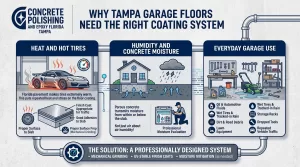
Tampa garages operate in a hot, humid environment, and concrete is porous. Moisture conditions within a slab can affect how well a resinous coating adheres over time.
That makes preparation especially important here.
Local garage-floor contractors commonly account for moisture, heat, and hot-tire exposure when designing coating systems for Tampa-area concrete. Current Tampa flooring companies also emphasize mechanical grinding, moisture evaluation, and UV-stable finish coats as important parts of installations intended for Florida conditions.
Heat and Hot Tires
Vehicle tires can become very warm after driving on Florida pavement. When a vehicle is parked, that heat places repeated stress on the coating beneath each tire.
A properly designed system needs both good adhesion to the slab and a finish coat appropriate for vehicle traffic. Simply applying a thicker coat does not solve weak surface preparation.
Humidity and Concrete Moisture
Humidity by itself is not the only concern. Concrete can also transmit moisture from within or below the slab.
If moisture conditions are significant, the coating system may need to account for them before the decorative layers are installed. This is one reason a professional assessment of the existing concrete matters before work begins.
Everyday Garage Use
Garages also see:
- Oil and automotive fluids
- Wet tires and tracked-in rain
- Dirt and road debris
- Lawn equipment
- Storage racks
- Dropped tools
- Repeated vehicle traffic
A good garage flooring system has to work as a floor first. Appearance matters, but it should not be the only reason for choosing a coating.
Get a Free Epoxy Flooring Estimate
Speak with Our Team! Call Now!
How Professional Epoxy Garage Floor Coating Is Installed
Professional garage floor coating is a layered process. Exact materials and installation methods can change based on the concrete and selected finish, but a complete project generally follows several key stages.
1. Prepare the Concrete Surface
One of the most essential steps in the installation is surface preparation.
You get the garage cleaned up, and then its mechanically prepared with a machine such as a diamond grinder or shot blaster. This eliminates contamination from the surface and weak material while forming a profile for the new coating to adhere.
Note that mechanical preparation is unlike just cleaning off the concrete, or merely sanding it down a little bit.
A floor can be clean, but also too smooth, sealed or contaminated and to not allow for proper coating adhesion.
Surface preparation is included in our residential epoxy process at Concrete Polishing & Epoxy Florida, because long-lasting adhesion begins with the condition of the slab underneath the coating.
2. Repair Cracks, Pits, and Damaged Concrete
Once the surface has been opened up, cracks and damaged areas become easier to evaluate.
Pits, spalled areas, joints, and cracks may need repair before coating begins. Depending on the condition and type of defect, installers may use epoxy, polyurea, or another appropriate repair material.
We include concrete repair and crack filling among our residential epoxy flooring services.
Repair work matters because a decorative coating does not restore structurally unsound concrete by itself. The slab has to be suitable for the flooring system being installed.
3. Address Moisture Conditions When Necessary
Before applying the main coating, the slab should be evaluated for conditions that could affect adhesion.
Where moisture is a concern, the installation may require a moisture-control or moisture-barrier component appropriate for the coating system.
This step is easy to overlook because moisture problems may not be obvious from the surface. A garage slab can appear dry while still transmitting moisture.
For Tampa homeowners, that makes moisture evaluation more meaningful than it might be in a consistently dry climate.
4. Apply the Epoxy Basecoat
After the slab has been prepared and repairs are complete, the base layer can be installed.
A professional system may use a 100% solids epoxy basecoat, depending on the selected system and project requirements. The goal is to create strong adhesion to the prepared concrete and provide the foundation for the finished floor.
This layer also provides the color foundation for decorative flake, quartz, or other design treatments.
5. Add Decorative Flake, Quartz, or Pigment
While the base layer is ready to receive material, decorative elements can be added.
Common options include:
- Decorative vinyl flakes
- Quartz aggregates
- Solid-color systems
- Metallic pigments
Flake systems are popular in garages because they can create visual texture and help disguise minor dirt or marks between cleanings.
Metallic and solid-color floors offer a different appearance and can work well when the homeowner wants a cleaner or more dramatic finished look.
We offer solid colors, decorative flakes, and metallic finishes for residential epoxy projects, allowing the design to be matched to the garage rather than treating every installation the same.
6. Apply the Protective Topcoat
Topcoat, which forms the working surface of the completed system.
An installed system may be professionally coated with a UV-stable polyaspartic or polyurea clear coat over the epoxy and decorative level, depending on the installation. The top surface provides a shield against wear, chemicals, automobile traffic and other typical garage exposure.
This also has an impact on the overall sheen and texture.
Now, regarding the areas around an open garage door, you’d better pay some attention here to UV stability — you might think of the garage as being an interior space, but some light CAN penetrate a few more feet into these areas from sunlight.
Why Surface Preparation Matters More Than Most Homeowners Expect
If there is one part of a garage floor project homeowners should not judge by appearance, it is surface preparation.
Freshly coated concrete can look excellent even when the underlying preparation was weak. Adhesion problems often show up later.
The coating needs a suitable concrete surface to bond to. Dirt, curing compounds, sealers, previous coatings, oil contamination, and smooth concrete can interfere with that bond.
This is why professional installers commonly use mechanical grinding instead of relying only on chemical cleaning or light sanding.
The practical lesson is simple: when comparing quotes for a professional epoxy garage floor coating, ask how the contractor prepares the slab before asking how many colors are available.
Can You Coat an Older Garage Floor?
In many cases, yes. An older garage floor does not automatically need replacement before it can be coated.
What matters is the condition of the concrete.
A professional should look for:
- Existing coatings or sealers
- Cracks
- Pitting or spalling
- Oil contamination
- Moisture concerns
- Weak or deteriorated concrete
- Previous repairs
- Uneven areas
Some problems can be repaired as part of the preparation process. Others may require additional work before a coating system makes sense.
The important distinction is between concrete that looks old and concrete that is too damaged for a normal coating installation. Those are not the same thing.
Epoxy, Polyaspartic, and Hybrid Garage Floor Systems
Homeowners often hear several product names while researching garage flooring. The terminology can make comparison difficult because contractors may use epoxy, polyurea, polyaspartic, or combinations of these materials in different layers.
A hybrid system can use the strengths of more than one material. For example, epoxy may be used as the base layer while a UV-stable polyaspartic or polyurea product is used as the protective clear coat.
The better question is not simply, “Is this epoxy?”
Ask:
- What material is used against the concrete?
- How is the slab prepared?
- How are cracks and defects handled?
- Is moisture evaluated?
- What type of topcoat is used?
- Is the finish suitable for vehicle traffic?
- How does the system handle UV exposure near the garage opening?
Knowing the full system gives you much more information than the product category alone.
What Are the Benefits of Epoxy Garage Flooring?
A properly installed epoxy floor can make a garage cleaner, easier to maintain, and more resistant to the mess that bare concrete absorbs.
Easier Cleaning
Bare concrete is porous and tends to trap dust, stains, and spilled fluids.
Epoxy creates a smoother finished surface, so routine dirt and debris stay closer to the surface where they can be swept or cleaned away. Our epoxy floors are designed as low-maintenance surfaces for residential and commercial spaces.
Better Resistance to Stains and Wear
Garage floors are exposed to oil, grease, vehicle traffic, tools, equipment, and stored items.
A resinous coating provides a protective wearing surface over the concrete. The exact level of resistance depends on the coating system, thickness, preparation, and topcoat rather than the word “epoxy” alone.
A More Finished Garage
Coating changes the garage from exposed concrete into a finished part of the home.
Decorative flakes can create a practical, textured appearance, while solid and metallic systems offer more design control. The right choice depends on how visible the garage is, how heavily it is used, and the look the homeowner wants.
How Do You Choose a Garage Floor Coating Contractor in Tampa?
Choose a contractor based on the complete installation process, not just price per square foot or the promise of a glossy finish.
Before hiring someone, ask:
- How will you prepare my concrete?
Look for a clear explanation of mechanical surface preparation. - Will you inspect cracks and damaged areas first?
Repairs should be discussed before the coating hides the slab. - How do you account for moisture?
This is particularly relevant for concrete flooring in Tampa’s humid environment. - What materials are used in each layer?
“Epoxy floor” can describe several different systems. - What topcoat will protect the finished surface?
Ask specifically about vehicle traffic, chemicals, abrasion, and UV exposure. - How long before we can walk or drive on the floor?
Cure and return-to-service times vary by material and conditions. - What preparation is included in the quote?
A low estimate can look very different once grinding, repairs, old-coating removal, or additional slab preparation is required.
These questions make it easier to compare two proposals that may look similar on paper but involve very different amounts of preparation.
What Affects the Cost of Professional Epoxy Garage Floor Coating?
The cost of a professional garage floor coating depends on more than garage square footage.
Important pricing factors can include the condition of the concrete, amount of repair work, removal of an existing coating, chosen finish, coating system, number of layers, surface preparation requirements, and any unusual access or layout issues.
A relatively clean two-car garage with sound concrete is a different project from a floor with peeling paint, oil contamination, cracking, and previous repairs.
For that reason, an on-site assessment provides more useful pricing information than a generic per-square-foot number.
At Concrete Polishing & Epoxy Florida, homeowners can request a no-cost estimate and on-site assessment for epoxy flooring projects.
Is a Professional Garage Floor Coating Worth It?
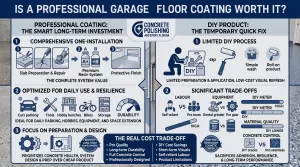
A professional coating makes the most sense when you want more than a temporary cosmetic improvement.
The value comes from combining slab preparation, repair, a suitable resin system, and a protective finish into one installation. That can be especially worthwhile for a garage used daily for parking, storage, hobbies, equipment, or as an extension of the home’s usable space.
A DIY product may still appeal to someone who mainly wants a low-cost visual refresh and accepts the limitations of doing the preparation and application themselves.
The trade-off is labor, equipment, material quality, and control over the condition of the concrete.
For homeowners planning to keep the floor for years, preparation and system design usually deserve more attention than finding the cheapest coating product.
Get a Free Epoxy Flooring Estimate
Speak with Our Team! Call Now!
Professional Epoxy Garage Floor Coating in Tampa
At Concrete Polishing & Epoxy Florida, we install residential epoxy floors for garages and other concrete surfaces throughout the Tampa area. Our process includes surface preparation and can include concrete repair, crack filling, solid colors, decorative flakes, and metallic finishes depending on the project.
We serve homeowners and businesses across the greater Tampa area, including Tampa, St. Petersburg, Clearwater, Brandon, Riverview, Wesley Chapel, and surrounding communities.
If your garage has bare concrete, an aging coating, cracks, stains, or a floor that is simply difficult to keep clean, we can evaluate the slab and discuss which coating approach makes sense for the space.
Request a free estimate to have your garage floor evaluated and learn which epoxy coating system fits your concrete, garage use, and preferred finish.
Frequently Asked Questions
Q: How long does a professional epoxy garage floor coating last?
A: There is no single lifespan that applies to every epoxy garage floor. Longevity depends on concrete preparation, coating materials, installation quality, moisture conditions, vehicle traffic, maintenance, and how heavily the floor is used. Proper surface preparation is one of the biggest factors affecting adhesion and long-term performance.
Q: Can epoxy be installed over a cracked garage floor?
A: Many cracks and damaged areas can be repaired before epoxy is applied. The important step is determining what caused the crack and whether the slab is otherwise suitable for coating. A coating can cover a repaired crack, but it does not correct an underlying structural problem.
Q: Will epoxy garage flooring peel under hot tires?
A: Hot tires can expose weak adhesion or an unsuitable coating system. Mechanical surface preparation, the basecoat, curing conditions, and protective topcoat all affect resistance to tire-related lifting. Tampa’s climate makes these details especially important.
Q: Is epoxy slippery when wet?
A: A smooth resin floor can become slippery when wet. Texture can be introduced through decorative aggregate or slip-resistant additives when additional traction is needed. The amount of texture should also consider how easy the homeowner wants the floor to be to sweep and mop.
Q: Should I choose flakes or a solid-color garage floor?
A: Decorative flakes are practical when you want visual texture and a finish that tends to disguise everyday dust and small marks. Solid colors provide a cleaner, more uniform appearance. Metallic systems offer a more decorative look. The best choice depends largely on appearance, garage use, maintenance expectations, and budget.
Q: Can an existing garage floor coating be recoated?
A: Sometimes. The existing coating must first be evaluated for adhesion and compatibility. Loose, peeling, or poorly bonded material may need to be mechanically removed before a new system is installed. Coating directly over a failing layer can transfer the same adhesion problem to the new floor.
Recent Posts