
Commercial Epoxy Floor Maintenance: Cleaning and Recoat Intervals
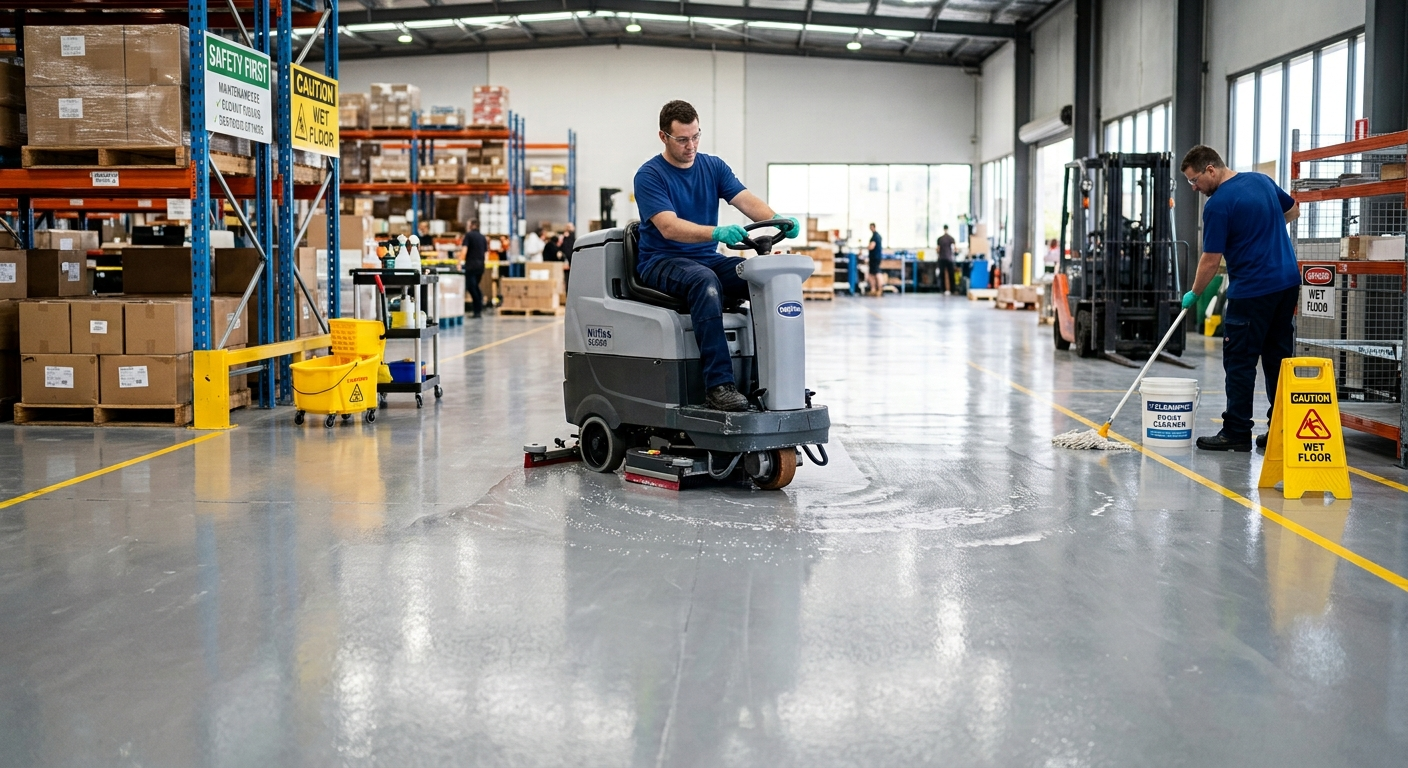
A couple of years after we coat a floor, we often get a call that starts the same way. Someone’s standing over a dull patch, usually in front of the busiest bay, and they ask, “Do I need a whole new floor, or is this fixable?”
Most of the time it’s fixable.
How fixable depends on what happened in the years in between. At Concrete Polishing & Epoxy Florida, we coat shops, warehouses and commercial spaces around Tampa Bay, and here’s what we’ve learned about epoxy floor maintenance from walking those floors later.
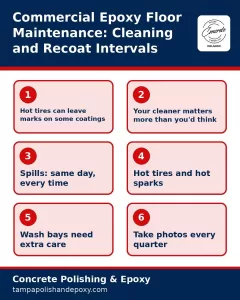
Key Takeaways
- Strong acids and some citrus or solvent cleaners can soften or etch certain epoxy topcoats.
- Hot tires can leave marks on some coatings.
- When the gloss fades and the tire lanes start to show a slight color change, that’s the point to catch it.
- Keep mats at every door, dust-mop at closing, and use a neutral cleaner with clean rinse water and fresh mop water.
Mats And A Dust Mop Do Most Of The Work
If we could get every customer to do one thing, it would be to put walk-off mats at every door from the first week and run a dust mop over the whole floor at closing time.
Sand, gravel and metal shavings ride in on boots and tires, and they grind across the floor like sandpaper, and over months those tiny scratches dull the gloss and wear the topcoat thin.
We see the proof of this all the time, because a customer lounge with mats at the door still shines years later. The service bay next to it, which gets all the grit, looks hazy.
Your Cleaner Matters More Than You’d Think
Strong acids and some citrus or solvent cleaners can soften or etch certain epoxy topcoats. Bleach and harsh degreasers can discolor the finish over time.
Soap-based cleaners cause a different problem, since they leave a film that holds dirt and makes the floor look dull and feel slick.
What works is a pH-neutral cleaner, mixed the way the label says, with clean rinse water. Change the mop water often, too, because dirty water just spreads the grit right back around the floor.
We’ve seen a cloudy, soft spot on a floor that came from two weeks of a new employee using a citrus degreaser. It only took two weeks, and the spot was still there years later.
Spills: Same Day, Every Time
Most epoxy coatings resist common oils and chemicals for a while. A spill that sits overnight is another story, though, since it can stain or soften the top layer.
Brake fluid, battery acid and some solvents are especially hard on coatings. Wipe those up right away and the mark usually stays shallow, or doesn’t show at all.
Hot Tires And Hot Sparks
Hot tires can leave marks on some coatings. Installers call that hot tire pickup.
If your vehicles come in straight off the interstate, it helps to park them in one spot for a few minutes to cool down. Better a couple of prints in one bay than prints everywhere.
Welding is another one to watch, because sparks and dropped hot parts scorch the finish. Keep a protective board under the welding corner.
Keep steel wool and stiff brushes in the cabinet, too, since they leave scratches that dull the finish.
Wash Bays Need Extra Care
A wash bay stays wet for long stretches. Where the coating curves up the wall at the cove base, small cracks can let water get behind it and lift the coating from below.
So squeegee water toward the drain after every wash, clear the drain weekly, and don’t let water pool along the walls.
This habit alone can save you from a much bigger repair.
Get a Free Epoxy Flooring Estimate
Speak with Our Team! Call Now!
Take Photos Every Quarter
This is our favorite tip, and it costs nothing. Pick a few spots on your floor and take a photo of the same spots every three months, from the same angle.
When you compare them later, you’ll see exactly when the busy lanes started to fade. It makes the recoat decision easy, with no guessing involved.
What A Maintenance Recoat Actually Is
When the gloss fades and the tire lanes start to show a slight color change, that’s the point to catch it. The coating underneath is still sound.
A maintenance recoat means we lightly sand the existing topcoat so the new layer can bond. Then we clean off every trace of dust and oil and roll on a fresh topcoat.
It goes on top of a coating that’s still well bonded, and it doesn’t touch the concrete underneath.
That’s far less work than grinding the whole floor back to bare slab. And it resets the clock on the gloss and the wear layer.
How Often?
Everyone wants a number here, but the honest answer is that it depends on traffic.
A shop might need a recoat every few years in the bays and much longer in the lounge. A warehouse with forklifts running two shifts might need its busiest lanes done sooner.
The floor itself is the best guide. That’s why we push the quarterly photos so hard.
What Drives The Cost Of A Recoat
The main factors are the square footage, how worn the topcoat is, how much spot repair is needed, and whether the work has to be phased around your business hours.
We phase a lot of jobs, so a shop that can’t close for a week might get two bays done per night across a few nights.
Waiting Too Long Is The Expensive Path
Once wear reaches the concrete, or once water lifts the coating at the edges, a simple recoat won’t cut it anymore. Then it’s grinding and a full new system.
That means more days closed and a much bigger project, so we’d rather catch it early.
The Routine, All In One Place
Here’s the short version. Keep mats at every door, dust-mop at closing, and use a neutral cleaner with clean rinse water and fresh mop water. Wipe up spills the same day, put a board under the welding corner, skip the steel wool, and take photos every quarter.
That’s really all epoxy floor maintenance is. It’s the same few habits, repeated until they feel boring.
You can learn about our epoxy floors, concrete polishing and concrete sealing in Tampa on our site.
For more, see joint sealing, concrete resurfacing, Brandon and contact us.
Get a Free Epoxy Flooring Estimate
Speak with Our Team! Call Now!
Keep Your Floor in Shape
Call (813) 440-8945 or request a free estimate to talk about epoxy floor maintenance or a recoat for your building.
Frequently Asked Questions
Q: How often should a commercial epoxy floor be recoated?
A: It depends on traffic. Busy lanes may need a maintenance coat every few years, while light areas last much longer.
Q: What should I clean epoxy with?
A: A pH-neutral cleaner, mixed as directed, with clean rinse water. Avoid harsh degreasers, acids and soap-based cleaners.
Q: Can a dull epoxy floor be restored without replacing the whole floor?
A: Often, yes. If the coating is still bonded to the concrete, a maintenance recoat can refresh the topcoat without removing the entire floor.
Q: What signs indicate that an epoxy floor needs a recoat?
A: Fading gloss, visible wear in tire lanes, or a slight color change can signal that the topcoat is wearing down. Regular photos can help you track these changes.
Q: How should I clean a commercial epoxy floor?
A: Dust-mop regularly, then use a pH-neutral cleaner mixed as directed. Rinse with clean water and change the mop water often to avoid spreading grit.
Recent Posts