
Commercial Epoxy Flooring: Durability and Spec Factors for Business Facilities
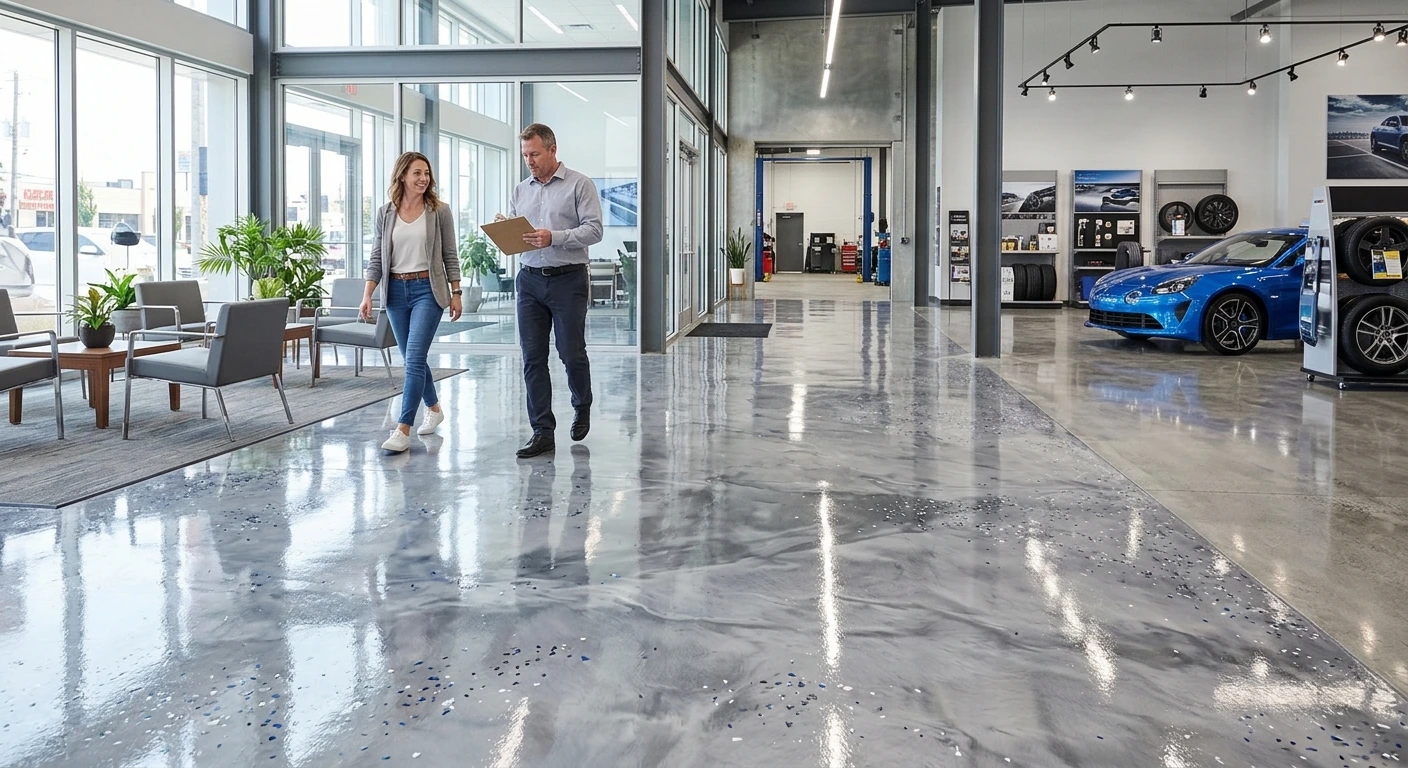
A distribution center in Tampa coats its floor in the spring. By the next summer, the coating is lifting in sheets near the dock doors, and white powder shows under the loose pieces. The epoxy itself was fine. The slab had not been ground, and no one tested it for moisture. Commercial epoxy flooring lasts as long as its spec allows: the prep, the system and the thickness. Concrete Polishing & Epoxy Florida installs epoxy for warehouses, shops, restaurants, showrooms and offices across Tampa Bay, and we check these factors before every project.
Key Takeaways
- Surface preparation decides whether the coating bonds to the slab or peels off.
- The system and its thickness should match the traffic, chemicals and cleaning in the space.
- Tampa’s humidity makes a moisture test necessary before any coating goes down.
- Traction additives and the finish affect safety as much as appearance.
Why Does Surface Prep Matter So Much?
Epoxy bonds by soaking into the pores of the concrete and locking in as it cures. Old sealers, oil, paint and laitance- the weak, dusty layer on top of a troweled slab- all block those pores. Diamond grinding or shot blasting removes that layer and leaves a rough profile. The industry measures that profile on the ICRI scale from CSP 1 to CSP 10, and most epoxy systems call for CSP 2 or CSP 3. Cracks and joints are filled before coating so they do not show through as lines in the finished floor.
Which System Fits Your Space?
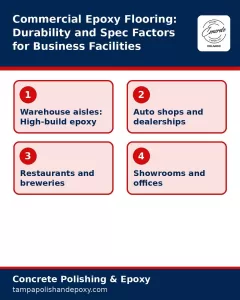
| Space | Common choice | Key factor |
| Warehouse aisles | High-build epoxy | Forklift wear and impact |
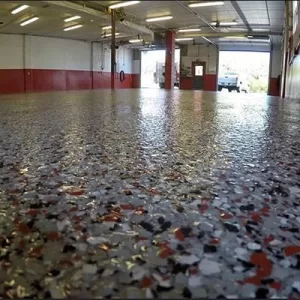
| Auto shops and dealerships | Epoxy with flake or quartz | Fluids and hot tires |
| Restaurants and breweries | Textured epoxy or urethane cement | Wet floors, cleaning chemicals |
| Showrooms and offices | Thinner decorative epoxy | Appearance |
Thickness is listed in mils, or thousandths of an inch. A thin roll-coat may be 10 to 20 mils. A high-build system for forklift aisles may be 30 mils or more. Urethane cement in a commercial kitchen is often a quarter inch thick, since it has to stand up to hot water and steam cleaning.
Get a Free Epoxy Flooring Estimate
Speak with Our Team! Call Now!
How Does Tampa’s Climate Affect the Job?
Florida slabs often sit on damp ground, and water vapor moves up through the concrete. If the vapor pressure under a coating is too high, it pushes the coating off from below. We test slabs with calcium chloride kits under ASTM F1869 or in-slab probes under ASTM F2170. When readings run high, a moisture-tolerant epoxy primer goes down first. Heat and humidity also change cure times, which affects when each coat can be applied.
What Should Be in the Spec?
A written spec lists the prep method and CSP target, the primer, the body coat, the topcoat, the total thickness, the slip resistance and the cure schedule. With those items on paper, an owner can compare bids from different installers line by line.
See our epoxy floors, concrete resurfacing and joint sealing services, or our page on commercial concrete flooring in Town ‘n’ Country.
How Does Epoxy Bond to Concrete?
Epoxy is a two-part system. One part is a resin, and the other is a hardener. When they are mixed, a chemical reaction links their molecules into a dense, rigid network. Before that reaction finishes, the liquid flows into the tiny pores of the concrete surface. As it cures, the epoxy locks into those pores, which is where most of its grip comes from. A smooth, sealed or dirty slab gives the epoxy nothing to hold, and the coating can peel in sheets later.
That is why commercial epoxy flooring jobs start with mechanical preparation. Diamond grinding or shot blasting removes the weak top layer of concrete, along with old sealers, oil and residue. The goal is a profile that feels like coarse sandpaper. Installers often compare the surface against standard profile chips so the texture matches what the coating manufacturer specifies.
Why Does Moisture in the Slab Cause Failures?
Concrete is porous and holds water long after it is poured. Ground moisture can also travel up through a slab that sits on soil without a vapor barrier underneath. When an epoxy coating is applied over damp concrete, that moisture keeps moving upward. It collects under the coating as vapor pressure and can push the coating off the floor in bubbles called blisters.
Testing measures the risk before any coating goes down. Installers can drill small holes and place probes in the slab to measure relative humidity, or they can tape a plastic sheet to the floor and check for condensation. When moisture levels are high, a moisture-mitigating primer can be applied first. That primer forms a barrier that holds back vapor so the rest of the system can bond.
How Does Cure Time Affect Your Schedule?
Epoxy needs time to cure before it can handle traffic. The reaction speeds up in warm weather and slows in cool weather. A coating that is ready for foot traffic overnight in a warm building may need longer in a cold one. Full chemical resistance and hardness usually take several days.
Businesses planning commercial epoxy flooring often schedule work around that window. Installation might happen over a weekend or a planned shutdown. Areas can be done in phases so that part of the facility keeps operating. Talking through the schedule early helps set expectations about when forklifts, carts and heavy equipment can return to the floor.
How Do Topcoats Change Performance?
The base epoxy layer gives strength and thickness. Topcoats add properties that the base layer lacks. A polyurethane or polyaspartic topcoat resists scratches better and holds its color under UV light, which matters in areas with large doors or skylights where sunlight hits the floor. Some topcoats are made to resist specific chemicals used in a facility, such as cleaning agents, oils or acids. Choosing the topcoat based on what will actually touch the floor helps the system last longer.
Get a Free Epoxy Flooring Estimate
Speak with Our Team! Call Now!
Get a Free Estimate
Call Concrete Polishing & Epoxy Florida at (813) 440-8945 or request a free estimate. We will review your space and recommend a commercial epoxy flooring system that fits.
Frequently Asked Questions
Q: How long before staff can walk on new epoxy?
A: It depends on the system and the temperature. We give you a cure schedule before work begins.
Q: Can epoxy go over an old coating?
A: Usually the old coating has to be ground off or removed so the new one can bond.
Q: Is commercial epoxy flooring slippery?
A: It can be when wet. We broadcast traction aggregate into the coating where grip is needed.
Recent Posts