
Epoxy Floor Warehouse: Thickness, Traction, and Traffic Ratings
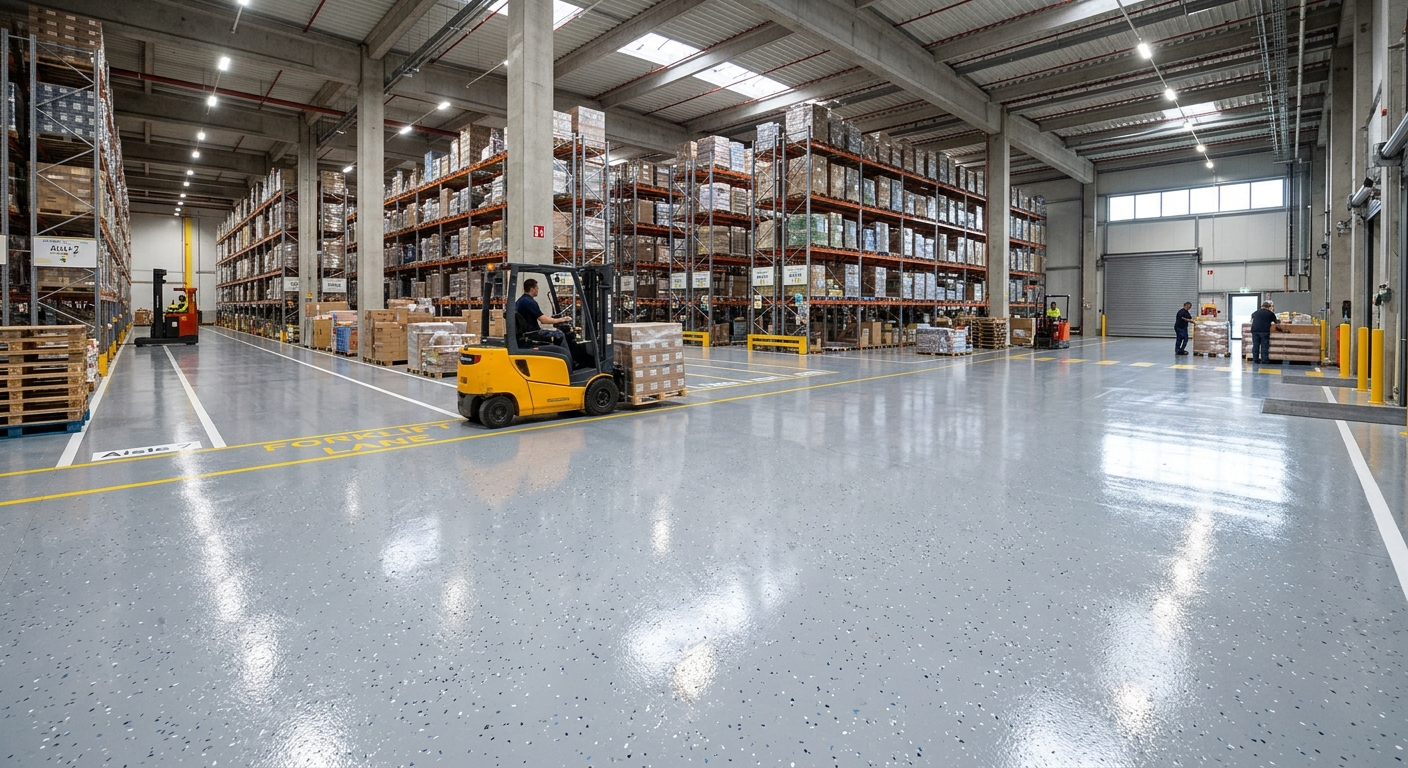
When a warehouse manager in Tampa Bay calls us about an epoxy floor, the conversation usually starts with dust. Bare concrete sheds a fine gray powder that settles on every box on the racks. Then they mention the forklift lanes by the dock doors, which are usually already chipped and worn.
And then the big one. “We can’t shut down for more than a weekend.”
That’s fine. We hear it on almost every epoxy floor warehouse job, and we plan around it. Here’s how we size one at Concrete Polishing & Epoxy Florida.
Key Takeaways
- Forklifts carry heavy loads on small, hard wheels, so a lot of weight lands on a tiny patch of floor.
- Smooth epoxy can get slick with dust or water on it.
- To keep the business running, we split the floor into phases.
- How long your epoxy floor warehouse coating lasts comes down mostly to daily cleaning and how fast your staff handles spills and damage.
We Spend The Walk-Through Watching
Honestly, we talk less than you’d expect on that first visit, because we’re busy watching how the building actually works.
Where do the forklifts turn? Which dock doors get the most trucks? Is there a wash-down area?
Forklifts carry heavy loads on small, hard wheels, so a lot of weight lands on a tiny patch of floor. Every turn grinds that wheel against the surface, and every stop and start adds a sliding force. After thousands of trips, soft coatings wear through and thin ones chip at the joints and edges.
We can usually spot the busiest lanes before anyone points them out. They’re the ones already showing damage at the edges and joints.
One Thickness Everywhere Doesn’t Work
This is the biggest mistake we see in warehouse bids. A plan that uses one thickness for the whole building either wastes material in the office or fails early at the docks.
So we map the floor by how hard each area works.
The front office and break room see shoes and the odd rolling chair, so a thinner coating handles that just fine.
Storage aisles see pallet jacks and forklifts all day long, so they get a high-build epoxy with more material.
Dock doors and the turning zones in front of the racks take the worst beating, with heavy loads and tires twisting in place, so those spots get the thickest build and a tougher topcoat.
A wash area stays wet, so it gets a textured finish for grip.
Joints Come Before Coating
Concrete slabs are cut into sections with control joints, so cracks form along those lines instead of wandering around. The joints move a little as the slab shrinks, swells and settles.
If you lay a rigid epoxy right over a moving joint, it can crack along that same line.
Forklift wheels banging across joint edges also break off chunks of concrete. That damage is called spalling, and most loading docks are full of it.
So we fix that first. Broken edges get rebuilt with a repair mortar. Joints get a semi-rigid filler that holds up a forklift wheel but still allows some movement. Random cracks get routed out and filled so they don’t telegraph through the new floor later.
Get a Free Epoxy Flooring Estimate
Talk with Our Team! Call Now!
Traction is Usually the Safety Manager’s First Question
That makes sense, since they’re the ones writing up incident reports when someone slips by a dock door.
Smooth epoxy can get slick with dust or water on it. To add grip, we broadcast a fine aggregate into the coating while it’s still wet.
The trick is balance, with enough texture to be safe but not so much that the floor is a pain to clean. Near dock doors, where rain blows in during summer storms, we add a little more.
Striping That Lasts
Most warehouses want aisle lines, a yellow pedestrian walkway and hazard zones around the charging station.
Paint on top of a coating wears off fast under wheels, so we mask the lines and lay a colored epoxy layer inside the system, then cover the whole floor with the same clear topcoat. The lines wear at the same rate as everything else.
We also keep a record of the layout, so when it’s time to recoat years from now, restriping is easy.
Tampa Weather is Part of the Plan
A lot of warehouses here aren’t fully air-conditioned. Summer heat pushes the slab temperature up, and humid air can condense on a cool slab early in the morning.
Both of those matter during an install. Epoxy sets faster in heat, which shrinks the time our crew has to spread and level it. Water on the surface can cloud the coating or weaken its bond.
So we track slab temperature and dew point the whole time. The slab has to stay a few degrees above the dew point. We start the heavy work in cooler hours and run fans and dehumidifiers to keep things steady while it cures.
Phasing Keeps You Open
To keep the business running, we split the floor into phases. Maybe one weekend covers half the aisles, the next weekend covers the docks, and the office goes in on a weeknight.
Each phase gets its full cure time before forklifts come back. Driving on a coating too early can leave marks or weaken it, and we won’t rush that, even when everybody wants us to.
The Order of Work in Each Phase
Every phase follows the same steps:
We grind the slab to open up the surface so the coating can grab it. A strong bond matters, because a weak one lets wheels peel up the edges of worn spots.
Then come the joint and crack repairs, followed by the base coat, the build coats, the aggregate, the stripe colors and the topcoat. It’s the same order every time.
What Changes On Day One
When the forklifts roll back in, the gray dust is gone. The coating seals the slab, so it stops shedding onto your inventory.
People usually notice that before they even notice the shine.
Keeping the Floor in Shape
How long your epoxy floor warehouse coating lasts comes down mostly to daily cleaning and how fast your staff handles spills and damage.
Grit from the yard acts like sandpaper under forklift wheels. We suggest daily sweeping and an auto scrubber with soft pads and a neutral cleaner.
Wipe up oil, battery acid and chemical spills quickly, since some of them can stain or soften the coating.
Every few months, walk the busiest lanes and look for early wear. A maintenance coat added in time keeps damage from ever reaching the concrete.
You can learn about our epoxy floors, concrete polishing and concrete sealing in Tampa on our site.
Get a Free Epoxy Flooring Estimate
Speak with Our Team! Call Now!
Plan Your Warehouse Floor
Call (813) 440-8945 or request a free estimate to talk through your epoxy floor warehouse project.
Frequently Asked Questions
Q: Can forklifts drive on epoxy?
A: Yes, with a system built for that load and after the full cure time.
Q: Can the work be done in phases?
A: Yes. We often phase warehouse projects to keep operations moving.
Q: How do you choose the right epoxy thickness for a warehouse?
A: It depends on how each area is used. Offices may need a thinner coating, while forklift aisles, dock doors and turning zones often need a thicker, more durable system.
Q: Can an epoxy warehouse floor provide traction near wet areas?
A: Yes. A fine aggregate can add texture to the coating for better grip. The finish should balance traction with ease of cleaning.
Q: How soon can forklifts return after installation?
A: Forklifts should return only after each section has fully cured. The timing depends on site conditions and the coating system, so follow the installer’s guidance.
Recent Posts